
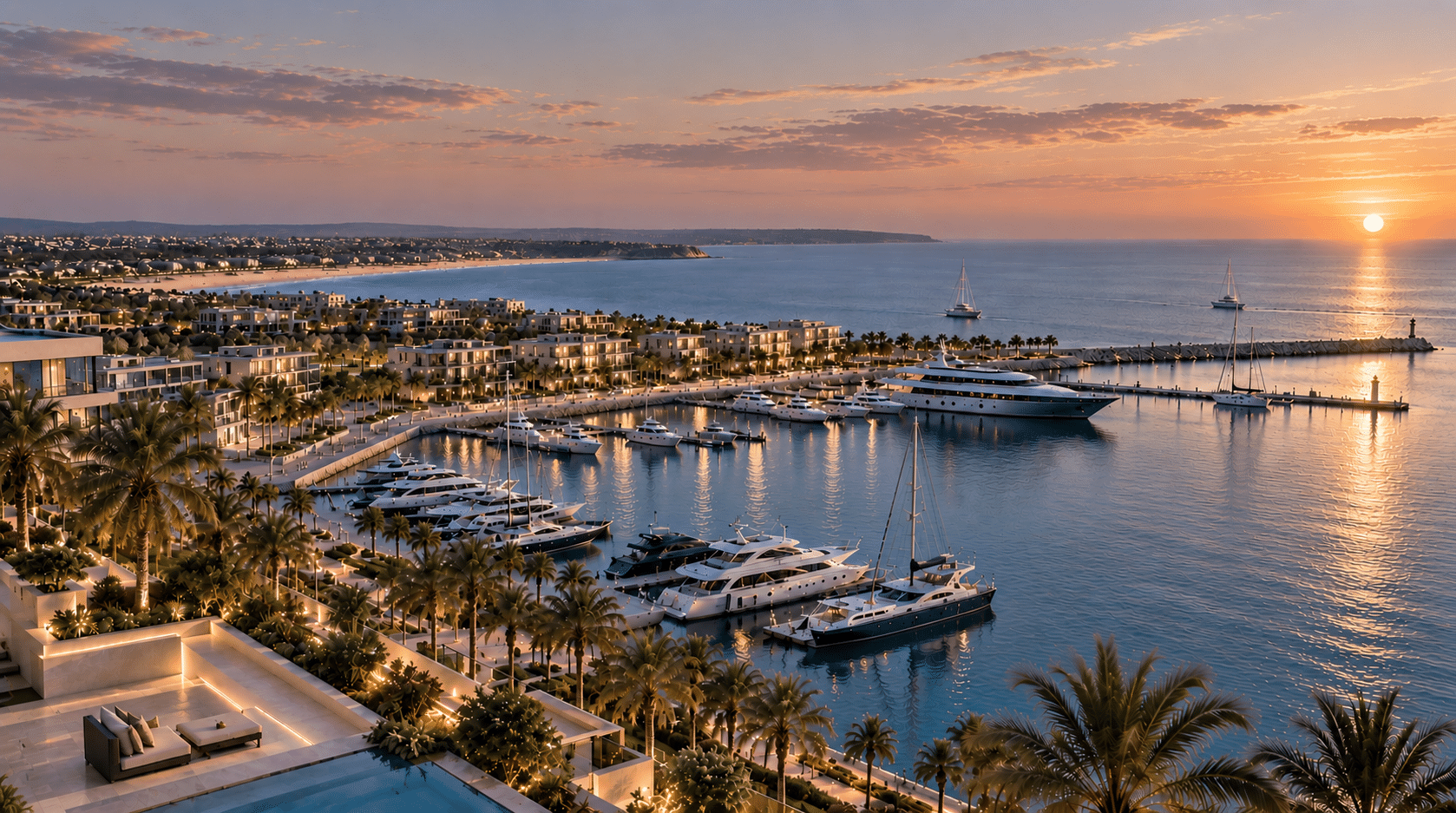
A foreigner can own two properties in Egypt, each up to 4,000 square metres, for personal and family use. That cap is still the law in 2026. What has changed is everything around it: exemptions, residency, currency rules, and the amount of foreign money arriving. Egypt sold roughly 1.5 billion dollars of property to foreign buyers in 2025, against 500 million the year before.
What follows is what is verified, what is still only a draft, and the one rule that stops a sale dead at the notary. Buying property in Egypt from abroad is more open than it was. It is not unlimited, whatever you have read.
Top real estate developers in Egypt
What Can a Foreigner Own in Egypt?
The governing statute is Law No. 230 of 1996, in force since 15 July 1996. Its terms are specific:
| Rule | What it says |
| Number of properties | Two maximum across the whole country, plus property needed for a licensed activity |
| Area | Up to 4,000 sqm each |
| Purpose | Personal residence of the owner and family |
| Resale | No disposal within five years of acquisition without an exemption |
| Vacant land | Construction must begin within five years, or the resale ban extends |
| Excluded | Properties classified as antiquities |
| Penalty | A disposal that breaks the law is void and cannot be registered |
The caps are not absolute. Article 2 carries a standing power to exempt buyers from both the number and the area, and Article 5 from the five-year rule. Prime Minister’s Decree No. 2031 of 2026, gazetted on 25 June 2026, moved those powers to the Minister of Justice. A third property is obtainable by application, not automatically.
Has Egypt Removed the Ownership Limits?
You will read that it has. The claim is not supported by any enacted law that we could find, in English or Arabic.
A Cabinet-approved draft removing the two-property cap has existed since July 2023, and a second was announced by the investment authority in November 2024. Neither passed. Meanwhile an Egyptian law firm restated the caps in April 2026, national press restated them in June 2026, and the June 2026 decree above delegates the power to exempt buyers from limits that would not exist if they had been abolished.
What did change is real, and worth knowing. Law No. 11 of 2024 eased the company-structure rules on desert land. Residency tied to property purchase was set out in 2023. The citizenship route opened to purchases from private developers, not only state ones. And the government now runs a property export platform, launching first in New Alamein, built to sell Egyptian homes abroad.
The Rule That Stops a Sale at the Notary
This is the one almost nobody mentions, and it matters more than the caps. Circular No. 41 of 25 March 2024, issued by the Real Estate Registration and Notarisation Authority, requires that a foreigner’s purchase price be transferred from abroad in foreign currency into a bank authorised by the Central Bank of Egypt.
If the contract is in Egyptian pounds, the equivalent still has to arrive as foreign currency. Notary offices are barred from notarising until the buyer complies. Cash on the ground does not satisfy it, and neither does money already sitting in an Egyptian account.
Keep the SWIFT documentation. Egypt’s own platform advises holding it as proof of transfer, and recommends full registration over the lighter route of court-validated signatures.
Do the Rules Change Depending on the Coast?
Yes, and this catches buyers out. A chalet in Hurghada and a chalet in Sharm El Sheikh are not the same legal product.
| Location | Ownership form | Note |
| North Coast | Freehold | Sidi Abdel Rahman and Ras El Hekma are designated tourist zones |
| Hurghada and Red Sea coast | Freehold | Also designated under the 2005 tourist zone resolution |
| Sharm El Sheikh | Usufruct only | Long lease rather than ownership of the land |
| Sinai | Usufruct only | Structures may be owned, land may not |
| Agricultural land | Prohibited | Closed to non-Egyptians under Law No. 15 of 1963 |
| Border and military zones | Prohibited | Security approvals govern access |
Those tourist zones, designated under Prime Minister’s Resolution No. 548 of 2005, also sit outside the five-year resale restriction, which is why the two coasts are where foreign buyers concentrate. Confirm the designation with a lawyer, because the published lists are not recent.
Who Is Buying Property in Egypt?
Honestly, nobody knows precisely, and that is worth saying out loud. Egypt publishes no breakdown of property transactions by buyer nationality. Turkey publishes one monthly. No research firm fills the gap. Every percentage you have seen assigning a share of the Egyptian market to one nationality is an estimate presented as fact.
What is documented:
- Knight Frank surveyed 264 wealthy individuals in September 2025 and found 1.4 billion dollars of capital intending to target Egyptian residential property, led by the UAE at 709 million, Saudi Arabia at 403 million and Germany at 263 million. That is stated intent, not purchases, and 42 per cent said they were not interested at all
- Property sales to foreigners, which Egypt calls real estate exports, reached about 1.5 billion dollars in 2025 against 500 million in 2024, according to the Real Estate Development Chamber
- Remittances from Egyptians abroad hit a record 36.5 billion dollars in 2024/25, and the government links part of that surge to selling land and homes in foreign currency
- Red Sea arrivals are led by Germany, then Russia, Italy, the United Kingdom and Poland, with Europeans above half the total. Visitors indicate where buyers come from. They do not measure it
One number puts the rest in perspective. The chief executive of a major Egyptian developer has said the country could earn more than 30 billion dollars a year from selling property abroad, against the 1.5 billion it earned in 2025. The international market is real, and so far small.
Does Buying Property Get You Residency?
Yes, on a sliding scale set by Minister of Interior Decision No. 977 of 2023:
| Property value owned | Renewable residency granted |
| From 200,000 US dollars | Five years |
| From 100,000 US dollars | Three years |
| From 50,000 US dollars | One year |
Citizenship is a separate framework with its own threshold, a minimum of 300,000 US dollars in property under the nationality law as amended in 2023.
Egypt has no official golden visa. The phrase is marketing. Residency and citizenship are separate regimes with different thresholds, and an Egyptian law firm has warned publicly against treating the 300,000 dollar citizenship figure as a residency number.
Best Red Sea investment opportunities in Egypt
The D5 Realty View
One correction to the story everyone is still telling. The argument that Egypt is cheap because the pound collapsed belongs to 2024. The pound appreciated about six per cent against the dollar across 2025, so a buyer converting euros or dollars today gets fewer pounds than one who bought in April 2025. Anyone selling the devaluation discount in 2026 is selling a two-year-old thesis.
The real case is better. Egypt is building coastal product at international standard, the hotel brands have arrived, the legal route for a foreign buyer is workable, and the government has an explicit policy of selling homes abroad for hard currency. That is a market opening up in an orderly way, which outlasts a currency window.
Retain an Egyptian real estate lawyer before you sign anything. This article is not legal advice and we are not lawyers. The rules carry exemptions, regional variations and unresolved points that only counsel reading your contract can settle. Contact D5 Realty and we will make the introductions alongside the property search.
Final Word
Egypt is becoming an international market the way these things usually happen: slowly, through currency rules, residency tiers and gazetted decrees rather than one announcement. The caps on buying property in Egypt remain, the exemptions are real, the money is arriving, and the paperwork is where deals are won or lost. Contact D5 Realty and we will tell you which applies to the home you are looking at.
Frequently Asked Questions
- Can foreigners buy property in Egypt?
Yes. Under Law No. 230 of 1996 a non-Egyptian may own up to two properties nationwide, each not exceeding 4,000 square metres, for personal and family residence, plus property needed for a licensed activity. Exemptions from those limits are available on application, and since June 2026 the Minister of Justice grants them.
- Has Egypt removed the two-property limit?
No enacted law removing it could be found. Draft amendments have existed since July 2023 and again in November 2024, but neither was passed. A law firm restated the caps in April 2026, and a decree gazetted in June 2026 delegates the power to exempt buyers from them, which confirms they still stand.
- How must a foreigner pay for property in Egypt?
Since March 2024 the purchase price must be transferred from abroad in foreign currency into a bank authorised by the Central Bank of Egypt. If the contract is priced in Egyptian pounds the equivalent must still arrive as foreign currency, and notary offices cannot notarise the agreement until the buyer complies.
- Can a foreigner own property in Sharm El Sheikh?
Not as freehold. Sharm El Sheikh and the wider Sinai operate on usufruct, a long lease over the land with ownership of the structures only. Hurghada and the Red Sea coast, along with the North Coast, do permit freehold ownership for non-Egyptians, so the legal product differs by location.
- Does buying property in Egypt give you residency?
Yes, on a sliding scale under a 2023 interior ministry decision. Property worth from 50,000 US dollars grants one year of renewable residency, from 100,000 dollars three years, and from 200,000 dollars five years. Citizenship is a separate route with a minimum property value of 300,000 dollars.