
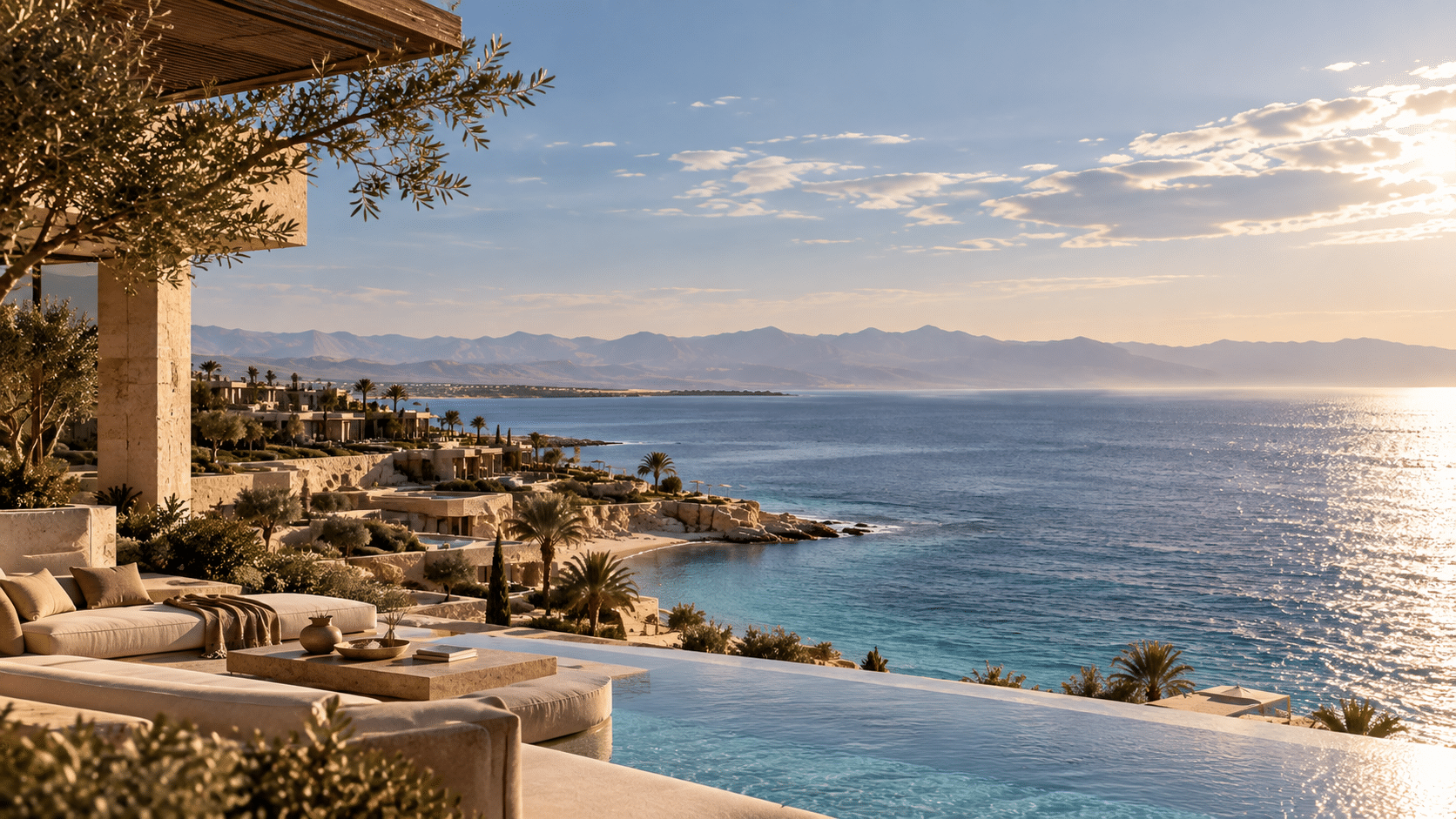
In February, the sea at Hurghada sits at 21 to 22 degrees. At Alexandria it is 17. That four to five degree gap is why Egypt has one coast that trades for twelve months and one that does not, and it is the whole case for the Red Sea year-round destination.
The proof is not a brochure claim. It is an admission from the other side. Toni Ghazal, Chairman of the Chamber of Hotel Facilities in Alexandria and the North Coast, told Al Borsa on 6 October 2026 that approximately 80 to 85 per cent of North Coast, Marsa Matruh and Siwa hotels cease operations during the winter season. The same article lists Hurghada and Sharm El Sheikh among the destinations that perform through the winter.
El Gouna, where this was proved first
How Warm Is the Red Sea in Winter?
Warm enough to swim in, which is the only question that matters. The air and rainfall rows below are WMO Climatological Standard Normals for 1991 to 2020, published by NOAA: thirty-year averages, not one good year. The sea row is aggregated reanalysis, because no meteorological authority publishes a sea-temperature normal for either site.
| Hurghada | Alexandria | Difference | |
| January mean daily high (WMO) | 22.2°C | 18.4°C | +3.8°C |
| Sea, February to March (reanalysis) | 21 to 22°C | 17°C | +4 to 5°C |
| Annual rainfall (WMO) | 7.9 mm | 211.6 mm | 27 times drier |
| July mean daily high (WMO) | 37.4°C | Not sourced here | Hurghada is hotter |
Two honest notes. The sea row is aggregated reanalysis rather than a measured official series, but it is corroborated by a source with no Egyptian interest: PADI states Red Sea diving is possible all year round with water temperatures from 21 to 28 degrees, which matches almost exactly. And Alexandria’s July figure is left blank on purpose, because we could not source it to the same WMO series and would rather leave a gap than fill one in.
The summer figures cut the other way. Hurghada averages 37.4 degrees in July and 37.5 in August, with August nights not dropping below 28, and the record is 47. Summer there is a dawn-and-dusk proposition, which is the honest reason the coast has two kinds of visitor rather than one.
Why Does the North Coast Close and the Red Sea Not?
Because the Mediterranean gets cold, wet and empty, and the Red Sea year-round destination does not. Alexandria takes 211.6 millimetres of rain a year to Hurghada’s 7.9. Its February sea is 17 degrees. Enterprise described the North Coast in August 2026 beginning its annual transition back to near-empty mode, and put the problem precisely: keeping the infrastructure running for a fraction of the footfall in October, let alone January, is a difficult proposition.
The numbers behind the emptiness are stark. An economics professor quoted by Al Jazeera put North Coast winter occupancy below 10 per cent in some areas, and a building custodian in Matruh described life there in winter as almost dead, shops closed and streets empty. Enterprise reports the coast expects 250,000 to 260,000 foreign tourists across the whole of 2026.
For scale, Hurghada airport alone handled 2,711,731 passengers in June to August 2026. That is roughly ten times the North Coast’s entire expected annual foreign intake, in three months, at one airport. Those are different metrics, tourists against airport passengers, so read it as an order of magnitude rather than a ratio. Our arithmetic, from two sourced figures.
Egypt knows this. Enterprise reports Tourism Minister Sherif Fathy’s stated objective is to turn the North Coast into a twelve-month destination rather than stretch a short summer. That aspiration for the Mediterranean is already the Red Sea’s working reality. Worth noting too that Emaar reportedly agreed to cover the costs of a medical hub at Marassi from October to April, because year-round service on that coast currently needs a subsidy.
Almaza Bay, which opened the North Coast’s far west
Do the Flights Keep Running in Winter?
They do, and two British carriers have now put it in writing. TUI’s own release describes its Cardiff to Hurghada route as resulting in year-round flying from Wales to Egypt. Jet2 has gone further and placed Egypt inside a programme it calls its winter sun programme.
| Carrier | Commitment | From |
| Jet2 | Hurghada and Sharm inside the winter sun programme; year-round from six UK airports, 18 weekly flights | February 2027 |
| TUI | Cardiff to Hurghada, giving year-round flying from Wales to Egypt | Winter 2026/27 |
| easyJet | Newcastle to Hurghada, twice weekly, winter programme | October 2026 |
| Wizz Air UK | Gatwick to Hurghada, weekly, sold as a winter escape | January 2027 |
| Nile Air | Seven European routes, six German cities plus Zurich | Announced June 2026 |
| Air Cairo | Oslo to Hurghada, weekly | Winter 2026 |
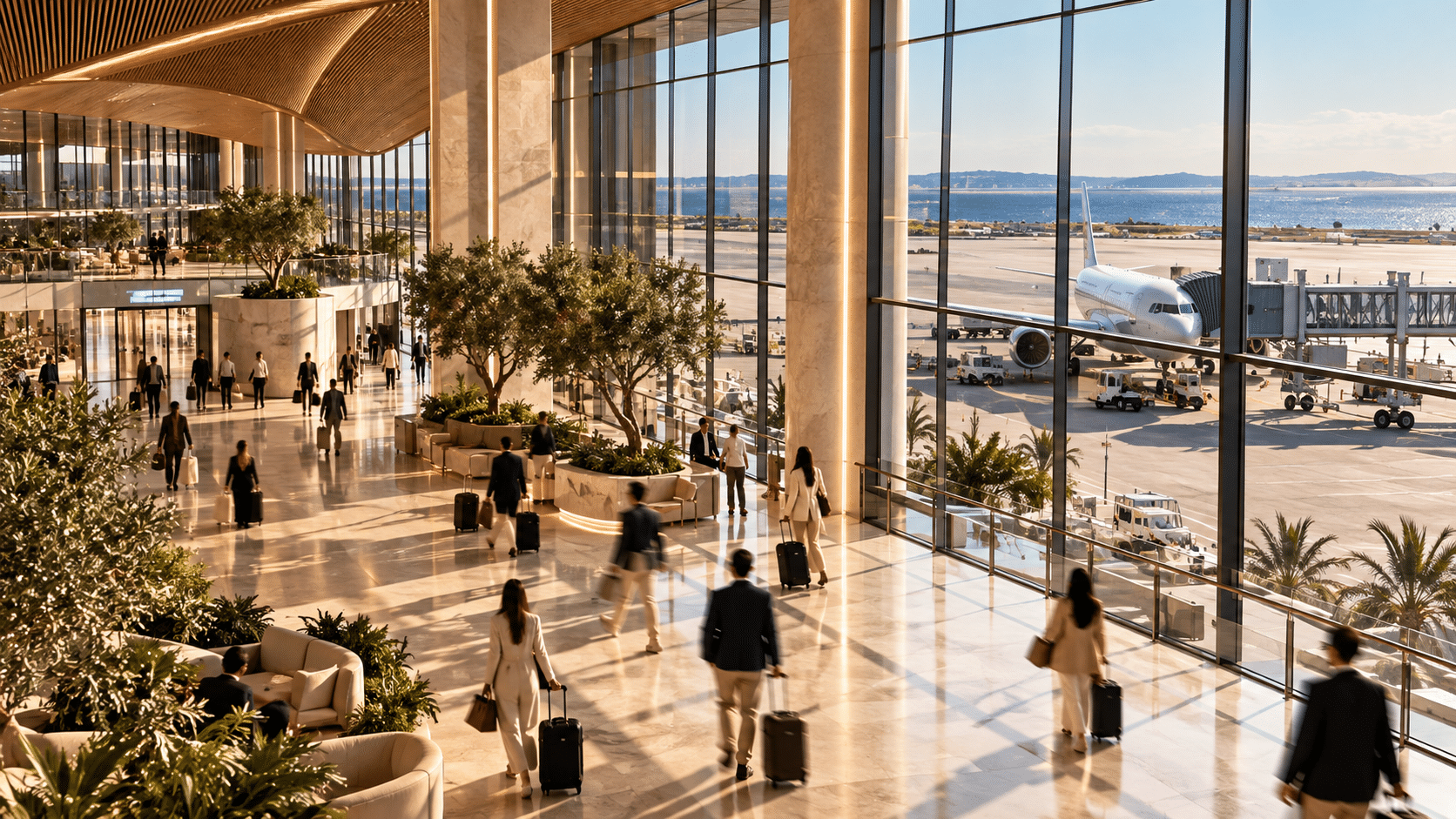
The strongest single piece of evidence is a comparison the airport’s own numbers allow. On 27 December 2025 Hurghada received about 150 international flights carrying roughly 30,000 tourists, Germany and the UK leading. On its peak July 2026 days it received 137 to 153. The winter peak and the summer peak are the same size. This is our arithmetic on press-reported counts, not a published comparison, and we would rather say so.
Hurghada’s record day was 53,169 passengers across 335 flights, on 25 October 2025, with around 56,000 following on 1 November. Both fall at the opening of the European winter season, not in August. Egypt now takes tourist flights from 193 cities, and charter traffic to the country rose 32 per cent in 2025.
Who Goes to the Red Sea Year-Round Destination in Each Season?
Europeans in winter, Europeans and Egyptians in summer. Al Dostor reported in July 2026 that Germans top the governorate’s visitors, followed by British, Polish, Czech, Italian, Belgian, Dutch, Swiss and Austrian, with occupancy across many hotels at 85 to 100 per cent. Across January to August 2026 Hurghada took about 3 million tourists from roughly 50 nationalities: Germany 825,800, Russia 638,800, Poland 303,000, the UK 245,700.
The mechanism was set out by the industry itself. Al Borsa’s headline on 20 September 2026 reads, in translation, that foreigners compensate for the decline in domestic winter demand at Hurghada hotels. Ramy Fayz of the Red Sea Hotels Chamber put it in one line: the European market is currently leading demand. Pickalbatros’s regional director credited the diversity of source markets.
That is the real reason there is no empty month, and it is not only the weather. Two demand pools overlap: Egyptian families fill the hotels through the summer holidays, peaking in August, and Europeans arrive as the Egyptian school year starts and stay to spring. Neither pool has to carry twelve months alone.
Named industry figures put Hurghada and Marsa Alam above 90 per cent in November 2025, 82 to 85 in early January 2026, around 90 in September 2026 and 85 to 90 projected for October. Treat those as claims by hoteliers about their own properties, because that is what they are. Egypt publishes no monthly occupancy series: the Ministry’s data by governorate is annual and ends in 2015.
Red Sea rising, the mega projects behind it
Can a Family Live on the Red Sea All Year?
El Gouna is the proof that the Red Sea year-round destination works residentially, and it is a narrow proof. On Orascom Development’s own figures: more than 25,000 residents from over 50 nationalities, 9,200 delivered units, 18 hotels with 2,800 rooms, four marinas, two golf courses, a hospital and an Egyptian Premier League football club, 30 minutes from Hurghada airport.
| What the coast has | What that means in practice |
| Four international schools | El Gouna International (British), Deutsche Schule Hurghada (IB), MES International and Sunrise International (both American). Four, on the whole coast |
| El Gouna Hospital | 40 beds, five departments, 16 clinics, 141 staff, 24-hour emergency, CT and MRI |
| Two hyperbaric chambers | HyperMed beside Hurghada airport and Baro Medical at Marsa Shagra |
| A graduate campus | TU Berlin Campus El Gouna, three Master’s programmes, about 58 students. A research campus, not a university |
| A winter events calendar | Boat show October, film festival October, Federation Cup November, half marathon November, IGFA Red Sea Championship January |
Note what that list is not. Read as constraints rather than features:
- Four international schools on the entire coast, which narrows your curriculum choice sharply
- Forty hospital beds in El Gouna, the coast’s best-equipped facility
- An events calendar weighted to autumn and winter, which tells you something about the rest of the year
- No reliable data on international retail, and no official count of foreign residents outside El Gouna
Egypt has no digital nomad visa, and we could not verify the current status of the five-year multiple-entry visa. If a long stay matters, that is a question for a lawyer rather than a brochure.
What Is the Honest Case Against?
February is the month nobody can show you. We searched in Arabic and English for Hurghada and Marsa Alam occupancy in February and March 2026 and found nothing. It is also the month Ramy Fayz of the Hotel Facilities Chamber predicted in January 2026 would begin to decline. A twelve-month claim with no February figure has a gap in it, and we would rather point at it.
The audited number is lower than the industry’s. STR and CoStar put occupancy at Egypt’s branded hotels at 64.5 per cent in 2024, twenty to thirty-five points below the chamber figures. Both are real and measure different things, but nobody has reconciled them.
Regional risk is measurable: arrivals fell about 16 per cent year on year in April 2026, and the Cabinet reduced airport fees at Hurghada and Sharm for June to August 2026 in response. Marine safety is the sharper risk for a family: a tourist submarine sank off Hurghada on 27 March 2025 with six deaths, the Sea Story went down in November 2024, and a 2024 Maritime Survey International assessment described the sector as operating with little to no regulation.
None of that unmakes the case. It does mean the Red Sea year-round destination argument should rest on the climate, the flight network and the two overlapping demand pools, all of which are documented, rather than on an occupancy percentage nobody can audit.
Final Word
The Red Sea year-round destination argument does not rest on marketing. It rests on a 21-degree February sea, on 7.9 millimetres of rain a year, on a winter peak day at Hurghada airport the same size as its summer peak, on two British airlines putting the word year-round in their own releases, and on the chairman of the North Coast’s own hotel chamber saying four in five of those hotels shut for the winter. Contact D5 Realty if you want a home on the coast that keeps working in January, and we will tell you which part of it suits the way your family uses a second home.
Ras Soma, the best kept secret
Best Red Sea investment opportunities
Frequently Asked Questions
- Is the Red Sea a year-round destination?
Yes, on the evidence available. The sea holds 21 to 22 degrees in February against Alexandria’s 17, PADI states diving is possible all year, and no Egyptian Red Sea hotel could be found closing for the season, while 80 to 85 per cent of North Coast hotels do.
- How warm is the Red Sea in February?
About 21 to 22 degrees at Hurghada, against 17 degrees in the Mediterranean at Alexandria. Air temperature averages a daily high of 22.2 degrees in January. PADI gives the annual Red Sea range as 21 to 28 degrees, which matches the aggregated reanalysis data closely enough to trust it.
- Why do North Coast hotels close in winter?
Rainfall and sea temperature. Alexandria takes 211.6 millimetres of rain a year to Hurghada’s 7.9, and its February sea is 17 degrees. The chairman of the Alexandria and North Coast hotel chamber said in October 2026 that 80 to 85 per cent of those hotels cease operations in winter.
- Are there direct winter flights to Hurghada?
Yes, and more are being added. Jet2 has placed Hurghada in its winter sun programme with year-round flying from six UK airports from February 2027. TUI describes its Cardiff route as year-round. easyJet, Wizz Air UK and Air Cairo all added winter services for 2026 and 2027.
- Can families live on the Red Sea all year?
El Gouna shows it works, with more than 25,000 residents from over 50 nationalities on Orascom Development’s own figures, plus 9,200 delivered units and a hospital. The constraints are real: four international schools on the whole coast, 40 hospital beds, and no digital nomad visa in Egypt.